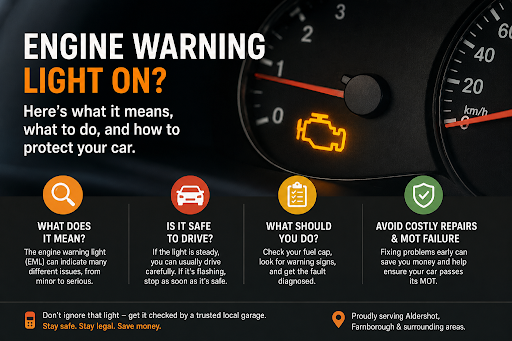
Engine warning light on? Find out what it means, whether it is safe to drive, and what steps to take to protect your car and avoid an MOT failure.
That small amber glow on your dashboard is one of the most unsettling things a driver can see, especially when it appears without warning on a busy road through Aldershot or on the way to work in Farnborough. Your first instinct might be to hope it goes away on its own. Sometimes it does. More often, it is your car trying to tell you something important before a small problem becomes an expensive one.
The engine warning light, also known as the engine management light or EML, is not a single signal with a single meaning. It covers a broad range of faults, from a loose fuel cap to a failing catalytic converter. Knowing how to read it, and what to do next, can genuinely save you money and keep you on the right side of the law.
What Is the Engine Warning Light?
The engine warning light is controlled by your car’s Engine Control Unit, or ECU. This is essentially the computer that runs your vehicle, monitoring dozens of sensors across the engine, exhaust, and emissions systems at all times. When a sensor detects a reading outside of normal limits, the ECU logs a fault code and switches on the warning light.
The light itself looks like a small engine outline, and it sits on your dashboard alongside other warning symbols. Unlike more specific lights, such as the oil pressure warning or the coolant temperature indicator, the EML does not point to one single issue. It is a general alert that something, somewhere in the engine or emissions system, needs attention.
That broad scope is exactly why drivers find it so confusing. The fault could be minor or it could be significant, and the light itself will not tell you which. What it will tell you is the urgency, through its colour and behaviour.
What the Colour and Behaviour of the Light Mean
This is the most important thing to understand before you do anything else. The way the light appears tells you how urgently you need to act.
Solid Amber or Orange
A steady amber light means the ECU has detected a fault and logged it. The car is usually still safe to drive for short distances, but you should book it into a garage as soon as possible. Do not ignore it and do not assume it will clear itself without investigation.
Flashing Amber or Orange
A flashing amber light is more urgent. It typically signals a serious engine misfire, which means unburnt fuel is entering the exhaust. This can destroy a catalytic converter very quickly, turning a manageable repair into a much larger bill. If your light is flashing, do not continue driving normally. Get to a garage promptly or pull over if the car is behaving unusually.
Red
A red engine warning light means stop. This signals a potentially critical fault that could cause immediate engine damage if you continue driving. Pull over somewhere safe, switch off the engine, and seek professional assistance. Do not continue your journey.
Understanding the colour and behaviour of the light gives you the first piece of the puzzle. The next step is checking for any obvious causes yourself before calling a garage.
Common Causes of the Engine Warning Light
There are dozens of faults that can trigger the EML, but some come up far more often than others. Here are the most frequent causes UK drivers encounter:
- Loose or damaged fuel cap. One of the most common and easiest to fix. If your fuel cap is not sealing properly, vapours escape the tank and affect the emissions system, triggering the EML. Check the cap first every time.
- Faulty oxygen sensor. The oxygen sensor monitors the fuel to air ratio in the exhaust. A failed sensor causes the engine to burn more fuel than necessary, reducing efficiency and increasing emissions.
- Catalytic converter issues. A clogged or damaged catalytic converter is a more serious fault that can affect both performance and emissions significantly.
- Mass airflow sensor fault. This sensor measures the amount of air entering the engine. When it fails, the ECU cannot calculate the correct fuel mixture, leading to rough running and poor fuel economy.
- Ignition system faults. Worn spark plugs or faulty ignition coils cause misfires, which can trigger the EML and, in some cases, cause the light to flash.
- Diesel particulate filter (DPF) blockage. Very common in diesel vehicles used predominantly for short journeys. A blocked DPF restricts exhaust flow and triggers the EML.
- Electrical faults. Corroded connectors, wiring issues, or a weak battery can confuse the ECU and produce false alerts even when no mechanical fault is present.
- EGR valve fault. The exhaust gas recirculation valve helps reduce emissions. When it sticks or fails, the EML lights up alongside changes in engine behaviour.
The only reliable way to identify exactly which fault has triggered the light is a diagnostic scan, where a technician connects specialist equipment directly to your car’s OBD port to read the stored fault codes.
What to Do Immediately When the Light Comes On
Do not panic, but do not ignore it either. Follow these steps in order:
- Check the colour and behaviour. Amber and steady means caution and prompt action. Flashing or red means stop as soon as it is safe to do so.
- Check the fuel cap. If you have recently filled up, pull over safely and check the cap is properly secured. A loose cap is one of the most frequent triggers and takes seconds to check.
- Look for any other warning lights. If the oil pressure light, coolant temperature light, or battery light are also on, the situation may be more urgent. Multiple lights together suggest a more serious underlying fault.
- Listen and feel. Is the engine running roughly, losing power, or making unusual noises? These symptoms alongside the EML suggest a more significant fault that needs immediate professional attention.
- Do not clear the light yourself without knowing the cause. Some drivers use a basic OBD reader to clear the fault code without fixing the underlying problem. This might switch the light off temporarily, but the fault remains, and clearing it without a repair can mask the issue and create problems further down the line.
- Book a diagnostic check. If the light is amber and steady and the car is driving normally, book a diagnostic check with a qualified garage as soon as possible. A typical scan at an independent garage in the UK costs between £40 and £80, and many garages will deduct this from the repair bill if work is carried out.
Is It Safe to Drive With the Engine Warning Light On?
The honest answer is: it depends. A solid amber light with no other symptoms and normal engine behaviour usually means it is safe to drive for a short distance to reach a garage. You should not be making long journeys, towing, or driving the car normally as though nothing has happened.
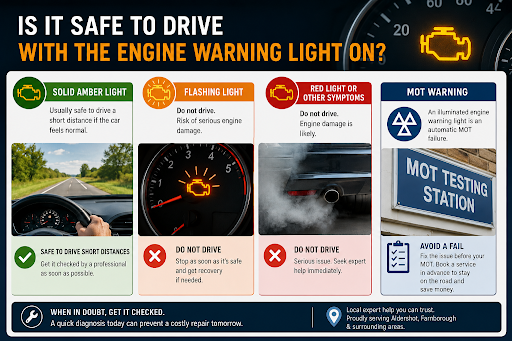
A flashing light, a red light, or a light accompanied by loss of power, rough running, or unusual noises means the car should not be driven. Continuing to drive under these conditions risks serious and expensive engine damage that could have been avoided entirely.
It is also worth knowing that an illuminated engine management light is an automatic MOT failure. Whether the light is amber or red, if it is on during your test, the vehicle will receive a major fault classification and fail. This makes addressing the EML before an MOT appointment essential, not optional. If your test is coming up, arranging a car service beforehand gives a qualified technician the chance to identify and resolve any faults before you arrive at the testing bay.
The Engine Warning Light and Your MOT
This catches a significant number of drivers out every year. Since stricter MOT testing rules were introduced, any car presenting for an MOT with an illuminated engine management light will automatically fail, regardless of what is causing it and regardless of how well the car seems to be running.
The MOT tester cannot simply note the light and move on. The presence of the EML is recorded as a major defect, and the vehicle cannot pass until the fault has been diagnosed, repaired, and the light has been cleared. The tester will also check that the EML illuminates briefly when you start the car and then goes out, confirming the system is working correctly. If the light does not illuminate at all on startup, that too can result in a failure because the tester cannot confirm the system is operational.
| EML Behaviour During MOT | Result |
| Light on at any point during test (amber or red) | Automatic major fault, MOT failure |
| Light does not illuminate on startup | Cannot confirm system function, potential failure |
| Light goes out after startup and stays off | Test proceeds normally |
| Light comes on during the emissions test phase | Major fault, MOT failure |
During an MOT inspection, technicians also assess other important safety areas such as the braking system. If you notice any brake warning signs alongside dashboard alerts, arranging brake repair in Aldershot can help resolve issues before they affect your vehicle’s safety or MOT result.
What Happens During a Diagnostic Check
When you bring your car in with the EML on, a technician will connect a diagnostic scanner to the OBD2 port, typically found under the dashboard near the steering column. This port has been a standard feature on UK cars since 2001 for petrol vehicles and 2004 for diesel.
The scanner reads the fault codes stored by the ECU. Each code points to a specific sensor, system, or component that has reported an issue. The technician will then interpret those codes in context, checking for related symptoms, testing the flagged components, and determining whether the fault is current or historical.
It is worth understanding that a fault code is a starting point, not a complete diagnosis. A code pointing to the oxygen sensor, for example, does not automatically mean the sensor needs replacing. It could indicate a wiring issue, an exhaust leak, or a fuel system fault that is producing an unusual reading. A skilled technician will verify the cause before recommending any repair.
For a more detailed breakdown of what triggers the engine management light and what the diagnostic process involves, the guide on engine management light causes and next steps covers the topic thoroughly.
When to Consider a Full Service Alongside the Diagnostic
There are situations where investigating the EML makes sense alongside a broader look at the vehicle. If your car has not been serviced in over a year, if you have noticed a drop in fuel economy alongside the warning light, or if the vehicle is approaching its MOT date, combining a diagnostic check with a full inspection is often the most efficient approach. Professional car repair services can help identify and fix underlying issues before they develop into more serious and expensive problems.
Regular servicing addresses the underlying conditions that often lead to EML triggers in the first place. Fresh oil ensures the engine is properly lubricated and running within normal temperature ranges. New spark plugs prevent misfires. Clean or replaced filters keep the fuel and air systems operating efficiently. Drivers who stay on top of servicing tend to see far fewer warning light events than those who let maintenance slide.
Understanding how much a car service costs in the UK is useful if you are trying to budget for maintenance, particularly when combining it with a diagnostic check or repair.
Typical Repair Costs Once the Fault Is Identified
Once the diagnostic scan has pinpointed the cause of the EML, repair costs will vary depending on the fault. Here is a general overview of what drivers in Hampshire and across the UK can typically expect:
| Fault | Approximate Repair Cost |
| Loose or damaged fuel cap | Under £20 |
| Spark plug replacement | £70 to £150 |
| Oxygen sensor replacement | £100 to £250 |
| Mass airflow sensor replacement | £100 to £300 |
| EGR valve cleaning or replacement | £100 to £400 |
| DPF clean or replacement | £100 to £1,000 depending on severity |
| Catalytic converter replacement | £150 to £900 |
These figures are approximate and will vary by vehicle make, model, and garage. What is consistent across the board is that addressing faults early, while they are minor, is almost always significantly cheaper than waiting until they escalate. A neglected oxygen sensor fault can destroy a catalytic converter, turning a £150 repair into something approaching £900 or more.
Conclusion
An engine warning light is not something to dismiss or wait out. It is your car communicating with you in one of the clearest ways it knows how, and responding to it promptly is always the right decision. Check the colour, note any other symptoms, inspect the fuel cap, and book a diagnostic scan without delay.
For drivers across Aldershot, Farnborough, Farnham, Ash Vale, Tongham, Ash, and North Camp, getting the EML investigated quickly protects your vehicle, protects your wallet, and keeps you legal on the road. Ignore it long enough and you risk a failed MOT, a more expensive repair, and the very real possibility of being stranded somewhere inconvenient. A short appointment with a qualified technician is a far better outcome than any of those alternatives.
Frequently Asked Questions
What does the engine warning light mean?
The engine warning light, or engine management light, alerts you when the car’s onboard computer detects a fault in the engine or emissions system. It can indicate anything from a loose fuel cap to a failing catalytic converter, and a diagnostic scan is the only reliable way to identify the specific cause.
Is it safe to drive with the engine warning light on?
If the light is a solid amber and the car is driving normally with no other symptoms, it is usually safe to drive a short distance to a garage. A flashing light or red light means you should stop driving immediately and seek professional help.
Will the engine warning light cause my car to fail its MOT?
Yes. An illuminated engine management light is an automatic MOT failure, regardless of colour or the specific fault causing it. The issue must be diagnosed, repaired, and the light cleared before the vehicle can pass its test.
How much does a diagnostic check cost?
Most independent garages in the UK charge between £40 and £80 for a diagnostic scan. Many will deduct this cost from the repair bill if they carry out the subsequent work.
Can I clear the engine warning light myself?
Basic OBD readers can clear fault codes, but this does not fix the underlying problem. The light will return if the fault persists, and clearing codes without a repair can mask issues that worsen over time.
What is the most common cause of the engine warning light?
A loose or damaged fuel cap is one of the most frequent triggers, particularly if the light appears shortly after refuelling. Other common causes include faulty oxygen sensors, spark plug issues, and DPF blockages in diesel vehicles.
Does the engine warning light affect my car insurance?
Driving with a known fault that makes the vehicle unroadworthy can affect the validity of your insurance policy. If you are involved in an accident and a fault is found that you were aware of, your insurer may not pay out.